Shields, HATs & Expansion Boards
Shields, HATs and expansion boards extend SBCs and development boards with sensors, relays and I/O, motor control, fieldbus (CAN, RS-485), audio, storage or UPS functions – no soldering required, via standardised formats such as 40-pin GPIO (Raspberry Pi HAT format), Arduino shield, mikroBUS Click, Qwiic and Grove. See also: Single Board Computers with 40-pin headers and Connectivity Expansions for radio interfaces.
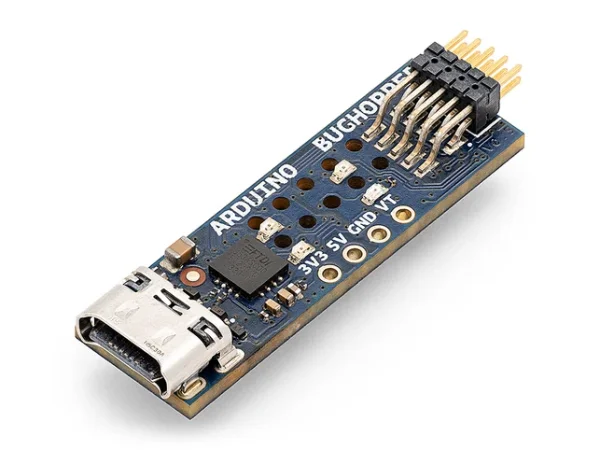
Arduino Bug Hopper ABX00156
- Concept: Arduino evaluation and development platform for early-stage hardware and application assessment
- Configuration: Publicly verifiable as an evaluation board with MPN ABX00156 from Arduino
- Use case: Suitable for development, test, and prototyping environments where system functions need early validation
- Development focus: Faster technical evaluation and proof-of-concept setups on an Arduino-related platform
- Design note: Verify actual features, interfaces, power requirements, and mechanical design against manufacturer documentation before design-in

Arduino UNO Breakout Carrier ASX00085
- Concept: USB-C cable for data and connectivity tasks between Arduino hardware and host/programming devices
- Configuration: Listed as a 24-PIN USB-C CABLE from Arduino; positioned as a specialized cable connection for development environments
- Use case: Suitable for programming, bring-up, and workstation cabling in Arduino and embedded setups
- Development focus: Consistent, repeatable board-to-host connectivity in lab, test, and demo environments
- Design note: Verify connector configuration, data role, charging/data behavior, and any adapter or host requirements against manufacturer documentation before design-in

Arduino UNO Media Carrier ASX00083
- Carrier concept to extend the UNO form factor with high-speed media connectivity
- Aligned with UNO Q bottom carrier headers such as JMEDIA (MIPI-CSI-2/MIPI-DSI, 1.8 V domain) and JMISC (mixed-function header)
- Relevant for embedded vision and HMI prototyping where camera and display signals are routed through a carrier
- Development focus: faster evaluation of camera/display peripherals and signal paths in a consistent UNO setup
- Design note: mind signal levels/domains (1.8 V / 3.3 V) – level shifting may be required depending on peripherals
Choosing the right expansion board
- Expansion format: 40-pin HAT, pHAT/bonnet, Arduino shield (UNO/MKR), mikroBUS Click, Qwiic/Grove – must match the board’s header
- Function: sensors, relays/I/O, motor control, fieldbus, audio, storage (SSD/NVMe), power/UPS, RTC, GPS/GNSS or prototyping
- Host interface: GPIO, I²C, SPI, UART, USB or PCIe – relevant for drivers and addressing
- Stackability: combine several expansions – watch address conflicts and power budget
Design-in support from our FAEs
We offer expansions matching the platforms and advise on selection, addressing and software integration. Contact our team.
Developer FAQs
Does a 40-pin HAT fit every board with a 40-pin header?
The HAT format defines pinout and dimensions – boards with a compatible 40-pin GPIO header can accept HATs mechanically and electrically. Whether all functions are usable depends on driver and BSP support; our FAE advises on this.
Can I combine several expansions?
Stackable formats allow it, as long as I²C/SPI addresses do not collide and the power budget is sufficient. We help with the configuration.
What is the role of fieldbus expansions?
CAN, RS-485 and Modbus expansions connect the compute platform to industrial control systems – the usual way to integrate an SBC into existing installations.
Not found the right product?
Our portfolio is larger than the web shop. Tell us your requirement – we will find the right platform, across all manufacturers.