Why Response Time and Measurement Range Drive Sensor Selection
Arc faults in photovoltaic systems, energy storage installations, and EV charging infrastructure generate characteristic current signatures in the microsecond range. Capturing these signatures reliably – and making them available to a downstream ML-based Arc Fault Detection (AFD) algorithm – requires a sensor that is both fast enough and low-noise enough to prevent weak arc patterns from disappearing into the noise floor. Both AKM families, CZ39 and CZ3K, meet this fundamental requirement with a 100 ns response time. The decisive differences lie in the maximum measurement range and the primary conductor resistance.
For power electronics designers working with SiC or GaN power devices, higher switching frequencies demand shorter reaction times throughout the protection chain. A sensor that reports an overcurrent or short-circuit event within 100 ns can, in combination with a fast digital signal controller such as Microchip Technology's dsPIC33A, keep the shutdown path short enough to protect semiconductors and system components from damage.
CZ39 vs. CZ3K: Technical Comparison
The table below summarizes the key differences relevant to sensor selection:
|
Parameter |
CZ3K Series |
CZ39 Series |
|---|---|---|
|
Response time |
100 ns |
100 ns |
|
Maximum range (family) |
Up to ±300 A |
Up to ±154 A |
|
Primary conductor resistance |
Typical 0.27 mΩ |
Typical 0.3 mΩ |
|
Variant selection |
CZ3K05: ±168 A; CZ3K07: ±300 A |
CZ3902 to CZ3907, varying ranges |
|
Typical target application |
Bidirectional OBCs, DC/DC converters, EV |
Industrial and residential power distribution, protection systems |
The lower primary conductor resistance of the CZ3K series reduces power dissipation at equal current compared to the CZ39 series. In systems carrying high continuous currents – such as bidirectional on-board chargers – this difference accumulates thermally and contributes to system miniaturization by reducing cooling requirements.
Decision Logic: Which Series Fits Which Scenario?
Sensor selection can be structured around concrete project parameters:
- If the maximum operating current stays below ±154 A and board space does not impose extreme miniaturization requirements, then the CZ39 series is a proven choice with broad variant coverage from CZ3902 to CZ3907.
- If the measurement range must reach ±300 A, or SiC/GaN topologies with high switching frequencies are used, then the CZ3K series with CZ3K05 (±168 A) or CZ3K07 (±300 A) provides the right variant.
- If ML-based arc fault detection is the primary objective and the reference design is built around Microchip's dsPIC33A, then the CZ3K series – adopted as a key enabling component in that AFD reference design – is the natural starting point.
- If power loss and heat generation in the primary path must be minimized, then the lower primary conductor resistance of the CZ3K series makes it the preferred option.
Both families are coreless current sensors, enabling galvanic isolation without a ferrite core and reducing footprint compared to conventional Hall sensors with a core. For industrial applications and infrastructure projects – including stationary energy storage and charging infrastructure – this is particularly relevant where weight and volume directly affect system cost and integration density.
Application Areas at a Glance
The fast current sensing capability of both families addresses several system levels:
- PV systems and energy storage: DC arc faults are difficult to extinguish and pose a serious fire risk. A sensor with a 100 ns response time delivers the raw data an AFD algorithm needs to distinguish arc signatures from normal switching transients.
- EV charging infrastructure and on-board chargers: Bidirectional OBCs with SiC or GaN stages switch at high frequencies. The current sensor must faithfully capture this dynamic without saturating – the ±300 A range of the CZ3K07 covers peak currents in high-power charging scenarios.
- Electronic fuses (eFuses): Flexible cutoff thresholds and configurable shutdown timing require the sensor to report current precisely and without delay. The 100 ns response time of both families enables this functionality.
- Industrial power distribution: Fast current sensors protect drives, inverters, and bus conductors from overcurrent and short-circuit events in demanding industrial environments.
The CZ3K series is in mass production; technical documentation and samples are available through Atlantik Elektronik as a design-in partner. As a distribution and development partner since 1977, our FAEs support projects from sensor selection through to series production – across manufacturers and with direct access to AKM design resources. The CZ3K Coreless Current Sensor Series in the ATE Store is the direct entry point for sample and project pricing requests. Explore our full range of solutions for power electronics and EV applications.
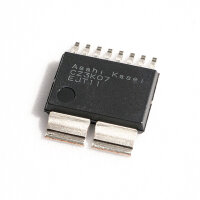
Featured in this article
CZ3K Coreless Current Sensor Series for EV – AKM CZ3K series
Lead time on request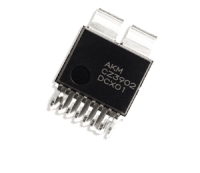
Featured in this article
CZ39 Series Automotive Coreless Current Sensor IC – AKM CZ39 Series
Lead time on requestFrequently Asked Questions: Selecting CZ39 or CZ3K
What are the concrete differences between CZ39 and CZ3K, and when does switching make sense?
Both families share the 100 ns response time and the coreless sensing principle. CZ3K extends the maximum measurement range to ±300 A (CZ3K07) compared to ±154 A for CZ39, and reduces primary conductor resistance from a typical 0.3 mΩ to 0.27 mΩ. Switching to CZ3K makes sense when higher operating currents, SiC/GaN topologies with high switching frequencies, or stricter requirements for primary-path power dissipation are present.
Can the CZ3K series be used directly as the sensing foundation for ML-based arc fault detection?
The CZ3K series has been adopted as a key enabling component in Microchip Technology's ML/AI-based AFD reference design featuring a dsPIC33A Digital Signal Controller. The sensor provides the fast, low-noise current signals required to capture arc fault signatures; actual detection and shutdown are performed by the downstream signal processing and protection circuitry within the overall system.
Are datasheets and samples available for CZ3K variants?
AKM has started mass production of the CZ3K series. Detailed datasheets for individual variants are not yet publicly available; technical documentation and samples can be requested through Atlantik Elektronik as a design-in partner.
Request a CZ3K Sample for Your AFD or EV Project
Atlantik Elektronik provides technical documentation and samples of the CZ3K series as a design-in partner – FAE support included.