Where these BMICs fit: AI server BBUs and energy storage
Battery backup units (BBUs) for AI servers and large energy storage systems (ESS) have one thing in common: long strings of series-connected lithium-ion cells, increasingly in 400 V and 800 V architectures. Every one of those cells needs to be monitored for voltage and temperature, because a single out-of-range cell can compromise safety and uptime for the whole system.
Nuvoton has introduced two stackable battery monitoring ICs for exactly this job, the KA49703A and the KA49713A. On paper they look almost identical. The difference only shows up when the battery is not in use, and for many designs that is precisely where the decision is made.
Samples are available now, and Nuvoton has announced September 2026 as the start of volume production. If you are evaluating parts or starting a design-in, this guide walks you through the shared feature set, the criteria that matter and which variant suits which scenario.
One platform, two variants: the shared feature set
Both ICs are built on the same platform, so your measurement chain, communication design and PCB footprint can be planned once for either variant.
- Cell channels: Each IC monitors up to 16 series-connected lithium-ion cells.
- Accuracy: Cell voltage is measured with an accuracy of ±2.9 mV.
- Stacking: Up to 55 ICs can be daisy-chained, with SPI as the host interface.
- Protection: Built-in alarms flag overvoltage, undervoltage, overtemperature and undertemperature.
- Supply range: Each IC operates from 12.5 V to 76.8 V.
- Ambient temperature: The devices are specified from −40 °C to +105 °C.
- Package: 48-pin QFP with a 7 mm × 7 mm footprint.
The daisy chain is what makes these parts interesting at system level. Instead of pairing every cell block with its own microcontroller and isolation barrier, a single host processor reaches every IC in the chain. According to Nuvoton, this removes the need for additional MCUs and isolation components. A fully populated chain of 55 ICs covers up to 880 cells, so the monitoring architecture scales in modules as the battery grows.
Three criteria that decide between them
With identical measurement, interfaces and package, the decision is not about performance during operation. It is about what happens while the battery rests.
1. How long packs sit idle. Between assembly, shipping, warehousing and commissioning, a battery pack can wait weeks or months. During that time the monitoring electronics keep drawing from the very cells they are meant to protect. The longer that period, the more the quiescent current matters.
2. Shutdown current. This is the measurable difference. Nuvoton specifies a shutdown current of 5.0 µA for the KA49703A. The KA49713A adds a dedicated shipping and storage mode that brings shutdown current down to 0.1 µA or less. Put into perspective: over one year, 5.0 µA adds up to roughly 44 mAh per IC, while 0.1 µA stays below 1 mAh. Multiply that by dozens of ICs in a large storage system and the gap becomes significant.
3. Start-up and wake-up concept. Nuvoton's comparison lists two start-up methods. The KA49703A starts via the daisy signal: in the reference design, the controller wakes the master IC through its WAKE pin and a command, and the master then wakes the slave ICs over the daisy chain. The KA49713A uses a dedicated start-up signal instead. How that signal is driven to wake the system from storage mode is part of your system design and worth settling early in the design-in.
KA49703A vs. KA49713A at a glance
All values below are taken from Nuvoton's product information.
|
Criterion |
||
|---|---|---|
|
Cell channels per IC |
up to 16 |
up to 16 |
|
Interfaces |
SPI and daisy chain |
SPI and daisy chain |
|
Daisy-chain depth |
up to 55 ICs |
up to 55 ICs |
|
Voltage accuracy |
±2.9 mV |
±2.9 mV |
|
Supply per IC |
12.5 V to 76.8 V |
12.5 V to 76.8 V |
|
Ambient temperature |
−40 °C to +105 °C |
−40 °C to +105 °C |
|
Package |
QFP-48, 7 × 7 mm |
QFP-48, 7 × 7 mm |
|
Shipping and storage mode |
no |
yes |
|
Shutdown current |
5.0 µA |
≤ 0.1 µA |
|
Start-up method |
daisy signal (master WAKE in reference design) |
dedicated start-up signal |
|
Best at |
waking the chain over the existing daisy link |
minimal drain during long storage |
Which IC fits your design?
The criteria translate into a straightforward decision path:
- If your battery goes into service shortly after production, for example a BBU installed straight into a server rack, then the KA49703A is the natural fit. It wakes the chain over the existing daisy link and needs no extra start-up signal.
- If your packs spend long periods in transit or on the shelf, such as spare modules or storage systems shipped worldwide, then the shipping and storage mode makes the KA49713A the stronger choice.
- If you are planning a product family with different deployment profiles, then consider both. The measurement chain, interfaces and package stay the same; only the wake-up concept needs to be designed per variant.
A quick sanity check helps: how long does a typical pack sit unused before its first charge? If the answer is days, the KA49703A will do. If it is months, the KA49713A is the safer bet.
Evaluation and design-in support
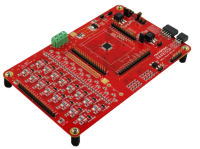
To get started, Nuvoton lists the KE-KA49703A evaluation board for evaluating both ICs. It lets you verify the measurement chain, daisy-chain communication and alarm behaviour on the bench before committing to your own hardware.
Atlantik Elektronik is an official Nuvoton distributor and design-in partner and has supported electronics projects since 1977. Our field application engineers help you choose the right variant, define the wake-up concept and plan samples and production volumes. Both ICs are available in the ATE Store, and you can explore more of the manufacturer's portfolio on our Nuvoton page. For industrial hardware, including energy monitoring, see our industrial solutions.
Featured in this article
Nuvoton KA49703A – Stackable Battery Monitoring IC, 16-Channel QFP-48
Available via the ATE store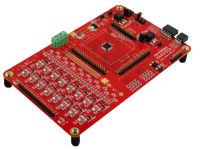
Featured in this article
Nuvoton KA49713A – Battery Monitoring IC, Daisy-Chain, QFP-48
Available via the ATE storeFrequently asked questions
What is the difference between the KA49703A and the KA49713A?
Both share 16 cell channels, SPI and daisy chaining of up to 55 ICs. Only the KA49713A offers a shipping and storage mode with a shutdown current of 0.1 µA or less, compared with 5.0 µA for the KA49703A. The KA49703A starts via the daisy signal, the KA49713A via a dedicated start-up signal.
How many cells can a daisy chain of these BMICs monitor?
Each IC monitors up to 16 series-connected lithium-ion cells, and up to 55 ICs can be daisy-chained. That covers up to 880 cells from a single host processor.
Which applications are the KA49703A and KA49713A designed for?
Nuvoton targets battery backup units for AI servers and large energy storage systems, including 400 V and 800 V architectures. The KA49713A is particularly suited to battery products with long shipping or storage times.
Request samples now
Test the KA49703A or KA49713A in your own design. The request form comes pre-filled with the part you choose.